


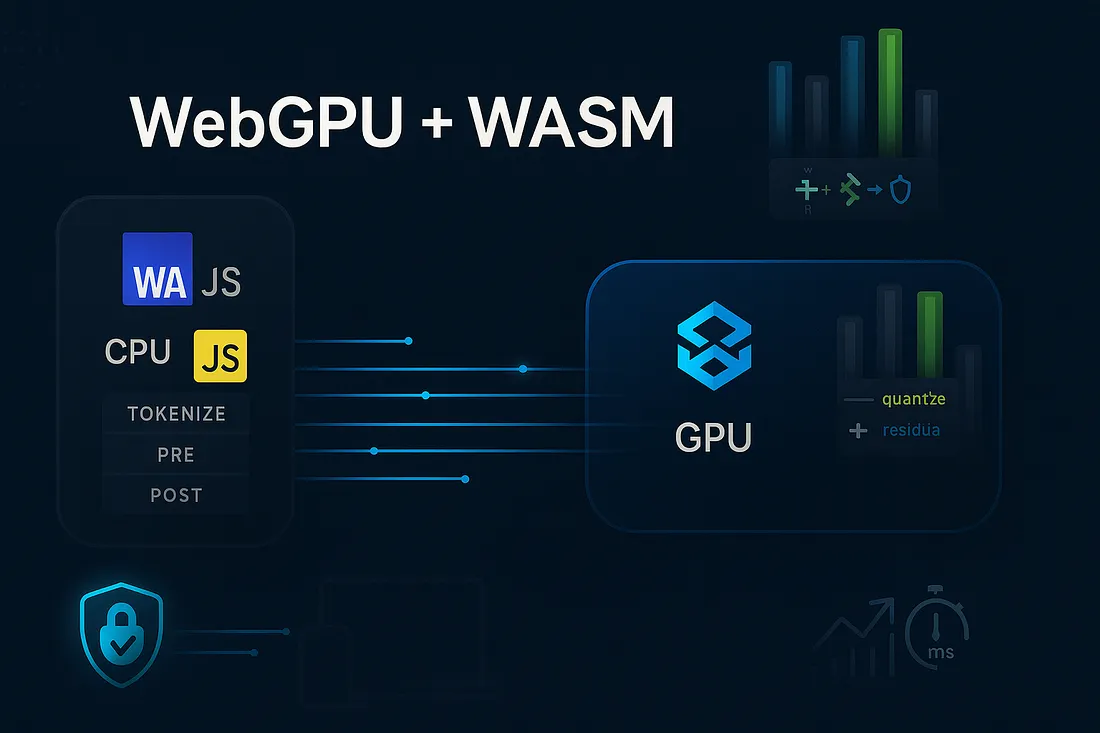
WebGPU and WebAssembly (Wasm) are the two technologies that make the modern web fast, GPU-accelerated, and capable of running AI models locally—something impossible just a few years ago.
1) WebGPU — The Next-Gen Graphics & Compute API
What is WebGPU?
WebGPU is the new GPU API for the browser, meant to replace WebGL.
It works similarly to Vulkan, Metal, and DirectX 12, giving low-level access to the graphics card.
Why WebGPU matters in 2025
-
5–10× faster than WebGL
-
Native GPU compute (critical for AI models)
-
Can run LLMs and image models directly in the browser
-
Modern, clean API
-
Better security and performance tuning
What WebGPU is used for
-
Running AI models (LLMs, image generation, vision)
-
Real-time 3D graphics
-
Browser-based games
-
Medical/architectural 3D tools
-
Image/video processing
-
Scientific simulations
Browser support
-
Chrome
-
Edge
-
Safari ⚠partial
-
Firefox ⚠experimental
2) WebAssembly (Wasm) — Near-Native Performance on the Web
What is WebAssembly?
WebAssembly is a binary format that allows languages like C, C++, Rust, and Go to run in the browser at near-native speed, inside a secure sandbox.
It’s the key technology that allows heavy, native-style applications to run in browsers.
Why WebAssembly matters
-
Extremely fast execution
-
Memory-safe and sandboxed
-
Portable across all browsers
-
Works with multithreading
-
Ideal for AI, games, simulations, and heavy UI apps
Typical WebAssembly use cases
-
Game engines (Unity, Unreal)
-
AI inference engines (ONNX Runtime Web, WebLLM)
-
Video / photo editors
-
CAD and 3D modelling tools
-
Scientific computing
-
Python, Rust, or C++ running inside a website
3) WebGPU + WebAssembly = High-Performance Web
Together, they enable native-level applications in the browser, without plugins.
WebAssembly handles:
-
Core logic
-
Heavy math
-
AI inference engines
-
Physics
-
Simulations
WebGPU handles:
-
Rendering
-
GPU shaders
-
Compute kernels
-
GPU acceleration for AI
Combined, they enable:
-
Stable Diffusion running entirely in the browser
-
Llama 3 or Mistral models on local GPU via WebGPU
-
Blender-like apps natively in Chrome
-
AAA-style browser games
-
Real-time video analysis + AI
Nothing to install. Everything runs in the browser.
4) WebGPU vs WebGL
| Feature | WebGL | WebGPU |
|---|---|---|
| GPU compute | ❌ No | ✔ Yes |
| Performance | Moderate | Very high |
| Based on | OpenGL ES | Vulkan/Metal/DX12 |
| AI support | ❌ | ✔ GPU compute native |
| Future-proof | ❌ | ✔ Modern API |
WebGPU replaces WebGL for any high-performance use case.
5) WebAssembly + Rust = The Best Combo
Rust has become one of the most popular languages for WebAssembly workloads.
Why Rust + Wasm is so strong
-
Memory safe
-
Fast
-
Great tooling (wasm-bindgen, wasm-pack)
-
Perfect for multithreaded workloads
-
Works beautifully with WebGPU shaders and compute pipelines
In 2025, many AI inference engines are now written in Rust + WebGPU.
In Summary
-
WebGPU = next-gen GPU API → 3D + AI compute
-
WebAssembly = near-native execution in the browser
-
Together → they enable full-power applications directly in the browser, including AI models, games, editors, simulations, and more.
